
Bowl vibrator or trough vibrator? 8 key differences to consider when choosing your system
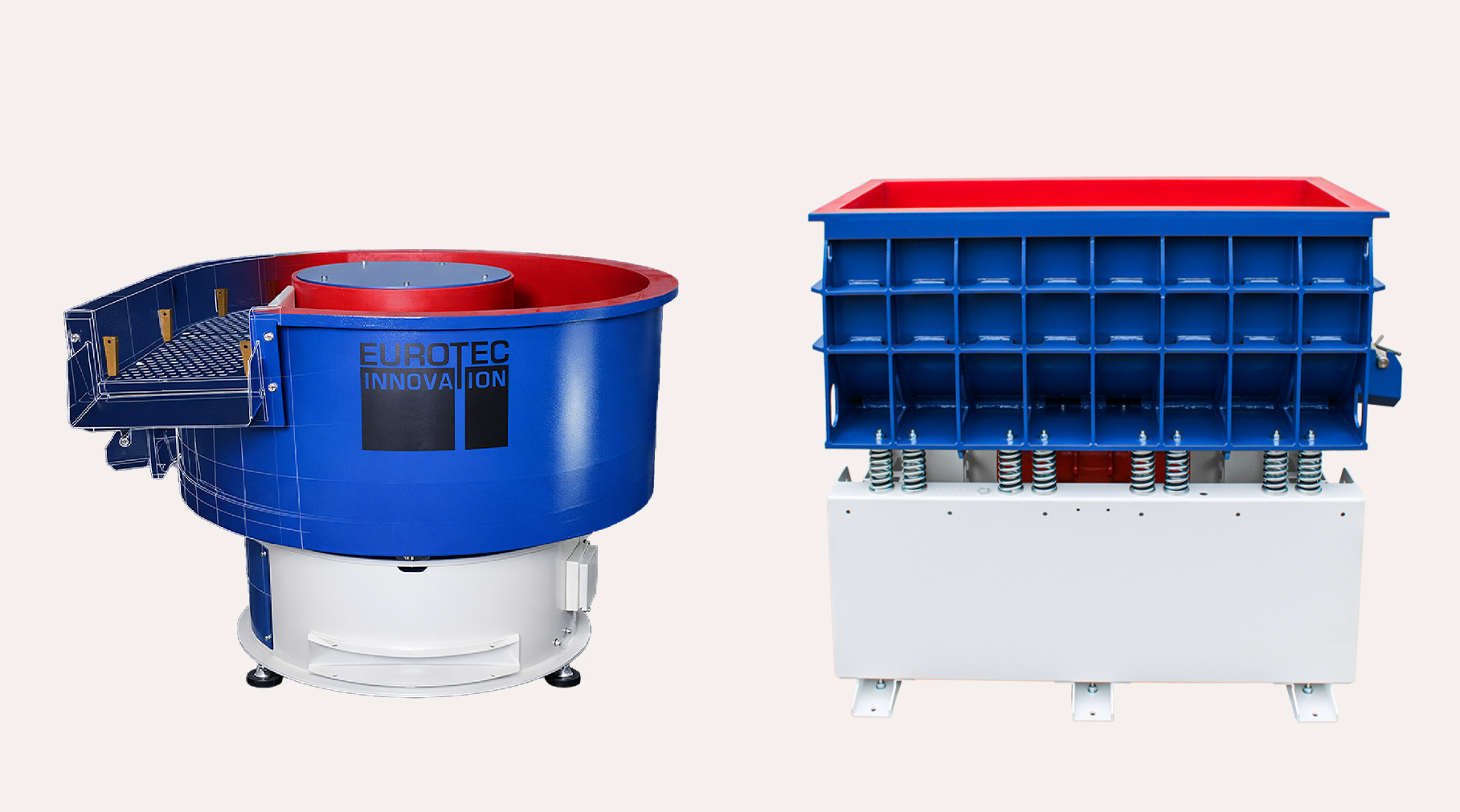
1. Difference: Part size
Bowl vibrators are particularly efficient when processing many small to medium-sized parts simultaneously. The circular motion creates a consistent process that is well-suited for series applications.
Trough vibrators, on the other hand, offer more space for larger or elongated workpieces. They allow for controlled processing when parts must not be mixed too vigorously or damaged.
2. Difference: Part geometry
The shape of the part plays a central role. Round, compact, or robust parts are often well-suited for processing in a bowl vibrator. Complex, long, or delicate parts may be better handled in a trough vibrator.
Typical questions to consider:
- Is the part long or bulky?
- Can parts get tangled with one another?
- Are there delicate edges or surfaces?
- Does the part require particularly gentle handling?
3. Difference: Process motion
The bowl vibrator creates a continuous, circular motion of parts and media. This motion ensures uniform processing and is particularly suitable for many standard applications.
The trough vibrator operates with a different motion characteristic, offering more control over larger workpieces or specialized applications.
4. Difference: Batch size
When many parts need to be processed at once, the bowl vibrator is often the more economical choice. It can process high volumes efficiently.
The trough vibrator is often the better choice when batches are smaller, parts are larger, or a highly controlled process is required.
5. Difference: Part protection
For delicate parts, the degree of contact between them is critical. Depending on the application, excessive contact can cause scratches, dents, or deformation.
Trough vibrators often offer advantages here because larger or more sensitive parts can be processed more effectively. However, the specific assessment should always be based on the individual part.
6. Difference: Flexibility
Trough vibrators are often highly versatile when it comes to processing various component sizes and geometries. They are well-suited for applications where not every job is identical.
Bowl vibrators, on the other hand, excel in recurring processes with stable parameters and cost-effective series production.
7. Difference: Space in the process
The choice of system also depends on how the mass finishing process is integrated into production. Relevant factors include:
- Loading
- Unloading
- Separation of parts and media
- Drying
- Downstream transport
- Automation
The best solution is not just the right machine, but the right overall process.
8. Difference: Cost-effectiveness
The most cost-effective solution is not automatically the largest or most powerful system. The deciding factor is which system achieves the desired result reliably, reproducibly, and with the least possible effort.
Factors such as process time, scrap rates, operating effort, maintenance, media consumption, and throughput play an important role here.
Conclusion
Bowl vibrators and trough vibrators each have their own distinct strengths. A bowl vibrator is often the right choice for the cost-effective mass finishing of small to medium-sized parts. Trough vibrators are particularly well-suited for larger, elongated, or more delicate workpieces. The best decision is reached through a precise analysis of the component and a practical process test.
Weitere Blogbeiträge

Switching your existing mass finishing process to Eurotec media: 8 steps to stable series production
A secure transition begins by documenting the current process and establishing clear quality criteria. Next, suitable grinding media and compounds are selected, tested on actual components, and gradually integrated into the existing machine. The key is to evaluate not just the individual process media, but the entire system, including the equipment, media, water management, separation, drying, and cycle time.

Process media for mass finishing systems from other manufacturers: 7 points for a safe transition
In principle, Eurotec process media can also be used in existing mass finishing systems from other manufacturers. The decisive factor is not just the machine brand, but the interaction between the component, the processing goal, the system movement, the abrasive media, the compound, the water management, the drying process, and the process parameters. Before switching, the existing process should be documented, tested with actual components, and then carefully transitioned into series production.

Qualifying an alternative supplier: 8 steps for a resilient second-source strategy
A second supplier should be qualified not only commercially, but also technically and operationally. This involves prioritizing critical parts and requirements, testing sample parts, comparing results, verifying capacities and documentation, and defining a clear approval process. For vibratory finishing processes, the equipment, media, process water, drying, and quality objectives must additionally be considered as a complete, integrated system.